flock camera awareness
Mass surveillance is on your street.
And most people have no idea.
before you read further
A map of the cameras within a mile of your house is a more persuasive document than anything I could write. If the answer is zero, good - you've learned something true. If it isn't, everything else on this site is about your street, not a hypothetical one. Go to maps.deflock.org and search your address. More ALPR information can be found at stopflock.com
Everything below will mean a lot more once you know how many there already are around you.
what is flock safety?
Flock Safety is a private, for-profit company - not a government agency, not a police department. They market their cameras as Automated License Plate Readers (ALPRs) - a neutral-sounding tool for solving crimes. That's the pitch. In practice it's a mass surveillance network, licensed to police, HOAs, and businesses on a subscription.
Every time you drive past one of their cameras, it photographs your car, reads your plate, and logs your location and time into their private database. That's what they admit to. They call it "just metadata" and claim it's deleted after 30 days - but even taking those claims at face value, enough metadata builds a precise map of your life: your job, your doctor, your church, your friends, how often you see them. And the 30-day limit disappears the moment anyone flags your plate. What they actually do with the data beyond that is not public knowledge - they're a private company with no obligation to tell you.
It was never just the plate
Flock builds what it calls a Vehicle Fingerprint: not only the plate, but make, model, color, roof racks, dents and damage, wheel type - even where your bumper stickers sit. That means an officer can search for your car with no plate at all. Cover the plate and the car still identifies you.
A feature called Convoy goes further and finds vehicles that keep showing up near each other. That is not a search for a car. That is software inferring who your friends are from where you both parked.
Beyond vehicles: Flock's Condor PTZ cameras use AI auto-tracking to follow and zoom in on pedestrians. Researchers who took one apart found it photographs people on foot, finds no plate, and stores the image anyway. Their video cameras don't just log where you drive. They watch what you're doing.
And it doesn't stop where they say it stops. Leaked material reported by 404 Media showed Flock building a people-search product, Nova, designed to link plate data to data-broker records - turning a car sighting into a named person. Flock has also partnered with Ring to pull doorbell cameras into the same orbit. Every capability here arrived as a software update, not a new contract you got to vote on.
The police are just subscribers. Flock is the one collecting your data, storing it, and deciding who gets to see it. A private company - not elected, not accountable to you, not bound by the same rules as law enforcement - owns a record of everywhere you've driven. And they sell access to it. You never consented to this. There's no opt-out.
Flock is also not the only one doing this. Motorola Vigilant, Rekor, Genetec, and Axon sell ALPR systems that work the same way. Flock is simply the biggest, and the one most likely to be on your street.
Sources: Flock Safety · GovTech · ACLU · GainSec · Wikipedia
they're everywhere
- 90,000+ cameras deployed across the US
- 20 billion vehicle scans per month
- 6,000+ municipalities - police, sheriffs, city governments
- 49 states - if you drive in America, you're in the network
- 12 million searches logged by 3,900 agencies in 10 months
- <1% of scanned cars are connected to any wrongdoing
That last pair is the whole argument. The system scans everyone in order to find almost no one - and every one of those searches is a police officer typing a plate into a box with no warrant, no judge, and often no stated crime.
And it's not just police. Flock sells to HOAs, private businesses, schools, and neighborhoods. The camera logging your plate might be paid for by your neighbors' dues - and feeding directly into a law enforcement database they didn't know they were building.
How to spot one
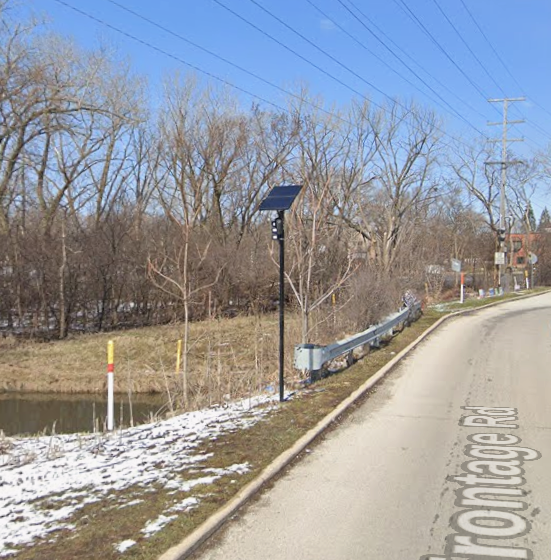
Black housing, roughly the size of a large book, mounted about 8 feet up on a dedicated pole - often near a neighborhood entrance, intersection, or exit ramp. Almost always has a small solar panel attached and a cellular antenna. The cameras are angled low toward the road, aimed at plate height, not elevated like traffic cameras. Sometimes marked with a small Flock Safety logo. See more at stopflock.com (independent site, not affiliated with this one).
Sources: EFF · U. Michigan Ford School · Atlas of Surveillance
claims vs. reality
- "Data is only used for solving crimes." The network is queried millions of times a year. EFF's review of 12 million searches found police using it for school residency checks, noise complaints, background checks, and immigration sweeps. Officers type a free-text reason - often one word, sometimes just "protest." Nobody checks it in real time.
- "Cameras cut crime dramatically." Forbes audited four of Flock's most-cited success stories and found cherry-picked windows. In San Marino, California - the town behind Flock's 70% claim - burglaries were higher in 2023 than before the cameras arrived. The full evidence is here.
- "We've never been hacked." In late 2025 and January 2026, researchers found dozens of Flock cameras wide open on the internet - no password, no encryption. Anyone could watch live footage, including of children on a playground, and scroll back 30 days. Flock called it a misconfiguration rather than a hack. That distinction does not help the people on camera.
- "We don't share data with ICE." Flock published a blog post saying exactly that. It rested on a technicality: federal agents were getting the data indirectly, through local police running searches for them. Flock later had to admit it held pilot contracts with CBP and DHS after its CEO said there were no federal contracts. The record is here.
- "Retention periods are short." Default is 30 days - but agencies can extend it, and once your plate is tied to an investigation, that record can be kept indefinitely.
- "It's just a license plate." A plate plus time plus location is a movement record. Enough of them maps your daily routine, workplace, who you see, and where you go for medical care. Flock's own Convoy feature exists to turn those dots into a list of your associates.
- "HOA cameras are community-owned." Most HOA Flock cameras feed directly into law enforcement networks. It's police surveillance - billed to your HOA dues.
- "It's legal because the town installed it." Municipalities pay for and install the cameras - that's the legal hook. Because a public entity contracted the service, Flock sidesteps rules that would apply to a private company collecting this data on its own. The towns install it. Flock keeps the data.
in their own words
Flock Safety CEO Garrett Langley, in a September 2025 Forbes video interview, on the people who map his cameras:
"Unfortunately, there's terroristic organizations like DeFlock, whose primary motivation is chaos."
"They are closer to Antifa than anything else."
Garrett Langley, CEO, Flock Safety
In December 2025, he emailed every law enforcement client calling critics "activists trying to let murderers go free" who want to "normalize lawlessness." Two police chiefs who received it pushed back - one called it "democracy in action," another called the email "unprofessional."
Flock also sent a cease-and-desist to deflock.org demanding they drop the name. The EFF represented deflock.org. They refused. The map is still up.
This is worth sitting with. A company whose entire product is watching you called a map of its own hardware - public objects, on public poles, in public view - an act of terrorism. They are comfortable observing you. They are not comfortable being observed.
as covered by PBS
On July 15, 2026, the PBS NewsHour ran a segment by correspondent Paul Solman examining the Flock Safety debate — bringing the questions this site raises to a national audience. The story put faces and voices to both sides, and the details are worth your time.
"When you have a national database of these cameras that can be queried by law enforcement without a warrant, that qualitatively shifts something about the surveillance."
Joseph Cox, 404 Media — on the PBS NewsHour
Chrisanna Elser — accused at her own door
A Denver resident who drives through Columbine Valley on her daily commute. Flock cameras logged her truck 20 times near the scene of a package theft. Police showed up at her door, picture in hand, and told her: "We have cameras everywhere in that town. You can't get a breath of fresh air in or out without us knowing." She was innocent. She proved it with her own dashcam footage, her own GPS history, and her own money spent on digital self-defense.
Her takeaway: "There's digital evidence out there that somebody has of you — you should have your own digital evidence."
the other side of the story
The segment also presented Flock's strongest case: a 14-month-old baby taken in a stolen car in Denver last December. Flock tracked the vehicle and reunited mother and child within hours. Aurora Police Chief Todd Chamberlain said flatly: "That technology saved that 14-month-old baby's life." Flock VP Josh Thomas cited roughly 800,000 to a million crimes solved per year with the technology — about 20 to 25 percent of all reported crime in America.
But Thomas also conceded the central question the segment was built around: "What's the trade-off we're making in society? Are we comfortable with that level of trade-off? And I think those are fair questions to ask."
exposed feeds, canceled contracts
The PBS segment covered YouTuber Benn Jordan accessing over 60 live Flock camera feeds last December — a story Joseph Cox at 404 Media also broke. Flock's Thomas said the leaked feeds were a small number of cameras mistakenly configured with public-facing IP addresses, all fixed within 48 hours. The segment also noted that in the past year, dozens of cities have canceled Flock contracts following public backlash.
Watch the full segment: PBS NewsHour — "Police say Flock cameras help solve crimes, but critics call them an invasion of privacy" (July 15, 2026)
find cameras near you
Independent tools - not affiliated with this site.
- deflock.org Community map of reported Flock camera locations. The original, and the best place to report one you spot.
- Have I Been Flocked Pulls FOIA'd audit logs from agencies nationwide. Type your plate and see who searched it, when, and the reason they typed.
- Atlas of Surveillance - EFF Database of surveillance tech deployed by law enforcement across the US.
- OpenStreetMap Community-tagged surveillance cameras worldwide, including ALPRs.
what you can do
- Look up your own plate. Have I Been Flocked will tell you if an officer has searched it, and what reason they gave. Nothing makes this real faster.
- File a public records request. Ask your local PD how many Flock cameras they run, who can query the data, how long it's kept, and whether they use the NCIC immigration hotlist. A Washington court ruled this data is a public record.
- Talk to your HOA. Ask to see the data-sharing agreement. Most residents don't know one exists.
- Show up when the contract does. These cameras are approved at city council meetings, usually on the consent agenda with no discussion. ALPR.watch tracks upcoming meetings and will email you when one is scheduled near you.
- Contact your representatives. Push for retention limits, audit logs, and warrant requirements. 5 Calls makes it a two-minute phone call.
- Share this page. Most people have never heard of Flock Safety.
Cities from Austin to Denver to Evanston have already cancelled or rejected Flock contracts. This is not inevitable. See what's worked.